
If you are a beginner or part-time affiliate, an AI writing assistant can cut a four-hour article down to one. It can also publish three kinds of problem under your name: pages that no search engine has a reason to rank, affiliate links with no disclosure near them, and product claims that nobody checked.
This article gives you the three affiliate-specific tests I would run on any assistant before paying for it. It also covers the five types of tool you will meet while shopping, which jobs each type handles, and which jobs stay with you. It does not rank named products or quote prices. Plans, limits and features change often, so the useful part is the method, which you can repeat on whichever tools exist when you read this.
Why a generic AI writer can hurt an affiliate site
A general-purpose assistant is built to produce fluent, confident text on any subject. Nothing in that goal involves search intent, legal disclosure or whether a product does what the text says. Fluent and confident are exactly what make a bad affiliate page dangerous, because the errors read as if someone checked them.
Here is how that plays out on a real site.
Sameness. If you ask five people to prompt “write a review of [popular product]” and they use the same tool, they get five drafts built from the same patterns: the same intro, the same pros and cons list, the same verdict. Readers and search engines both see a page that adds nothing to what already exists.
Missing disclosure. An assistant writing a review has no reason to add a disclosure line unless you ask for one. Even when you ask, it may put the line in a spot nobody reads, or drop it when you ask for a rewrite.
Invented claims. When a prompt asks for a review and supplies little information, many assistants fill the gaps with plausible specifications, battery lives, ingredient lists or guarantee terms. A reader who buys because of a claim that was never true will not buy from you again, and the merchant may remove you from the program.
None of this means you should avoid AI. It means the draft is a starting point, and you need to know which parts of it to distrust.
The three tests every tool gets
Run each assistant through the same three tests with the same prompt. Score each one pass, partial or fail, and keep the scores in a simple note.
Test 1: does the draft support real SEO work?
An assistant that writes a nice paragraph about your topic has not done SEO. Check these specific things:
- Search data. Does the tool show real keyword information (search volume, competing pages, related questions), or does it only guess at what people search? A guess is acceptable for brainstorming and unacceptable as the basis for a content plan.
- Structure. Does it produce a sensible heading outline that matches what the searcher wants, with the target keyword in the title and an early paragraph, and variants used naturally?
- Search intent. Ask for an article targeting a “best X” phrase. A good draft compares options and helps someone choose. A weak draft explains what X is for 600 words and never recommends anything.
- Editing control. Can you adjust the outline before the full draft is written? Fixing a structure is far cheaper than rewriting finished text.
Test 2: does it keep affiliate disclosure in place?
In the United States the FTC expects a clear and conspicuous disclosure of your material connection to the merchant, placed close to the affiliate link and in language a normal reader will understand. Other countries have their own rules, and many affiliate programs add required wording to their terms. Check yours, because this article cannot tell you what applies where you live.
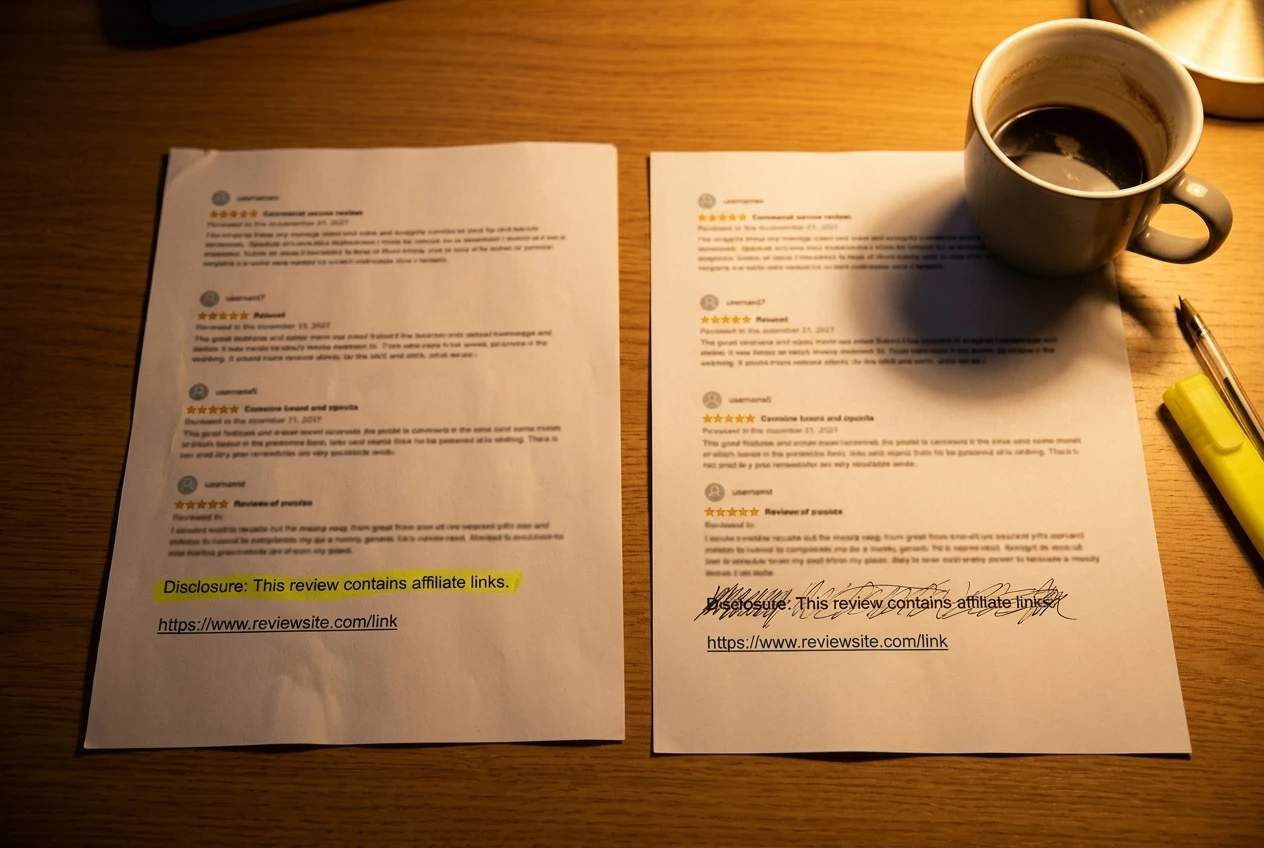
For the test, ask the assistant to include a disclosure, then ask for a rewrite of one section, then ask it to shorten the whole article. After each step, check whether the disclosure is still there, still near the links, and still plain. A tool that drops it on the second request will do the same at 11 p.m. when you are tired and in a hurry.
Test 3: does it avoid making up product claims?
This is the most important test, and it is simple to run. Give the assistant a product and only three verified facts about it, taken from the merchant’s own page. Ask for a full review. Then compare every factual statement in the draft with your three facts.
Anything that is not one of your three facts is either a general statement that applies to every product of this kind, or an invention. Count the inventions. A tool that stays inside your facts and says “I don’t have information about X” has passed. A tool that adds a battery life, a money-back period or a percentage has failed, however good the paragraph sounds.
The five tools side by side: price, strengths and where each falls short
The five assistants below are five types of tool, not five brands. Most products fall into one of these types, and the type tells you more about how a tool will behave than its marketing does. Prices are not listed, because they change; the third column shows how each type is usually sold, so you know what to look for on the pricing page.
Type How it is usually sold Strongest at Likely to fall short on General-purpose chat assistant Free tier plus a paid subscription Flexibility, rewriting, brainstorming angles, following detailed instructions Search data, unless it is connected to a source; invented specifics when facts are thin SEO content platform Monthly subscription, often with limits on articles or projects Keyword research, outlines, scoring a draft against competing pages Voice (drafts can read generic), and cost for a site that publishes little Marketing copy template tool Subscription or credit-based plans Fast short copy: headlines, product blurbs, email subject lines Long articles, and depth on any one product Editor and rewriter Free tier plus subscription Cleaning up your own draft, tone and clarity Starting from nothing, and any SEO planning Assistant built into your site platform Often bundled with hosting or a membership Writing where you publish, so fewer copy-and-paste steps Variable; check what it knows about search and disclosure before trusting it
A few notes on reading that table.
The general-purpose assistant is the cheapest way to start and the one that rewards good prompting. It is also the one most likely to invent a detail if you let it. The test prompt in the next section is built to catch that.
SEO platforms are worth considering once you publish regularly and want data behind your outlines. If you publish twice a month, the subscription may cost more than the time it saves.
Template tools shine at short pieces. Using one for a 2,000-word comparison is a mismatch.
Editors do not write for you, which is why they pair well with another tool. Draft in one place, tighten in another.
Built-in assistants save the most friction. Whether they save the most time depends on how well they handle the three tests, so run those tests on them like any other.
The same product review prompt, and what to look for in each output
Using the same prompt for every tool is the whole point. Change the wording between tools and you are comparing prompts instead of tools. Here is a prompt you can copy, with the bracketed parts replaced by your own product and facts before you run it:
Write a 600-word review of the product named below for a beginner audience. Use only the facts I give you. If you need a fact I have not given, say so instead of guessing. Include a clear affiliate disclosure before the first affiliate link. Suggest a title, an H2 outline, and a meta description of 150 characters or fewer, targeting the phrase I give you.
Then add the product name, your three facts, your target keyword and where the affiliate link goes. Write all five in the prompt itself so nothing is left open.
I have not included sample outputs from named products. Outputs change with every update, and a result that was true last month may not be true now. What follows is what each type tends to produce, as a guide to what you should check, not a record of results.
- General-purpose chat assistant: usually follows the instructions closely, including “say so instead of guessing.” Check whether it did. If it added specifications, the instruction was not enough and you will need to tighten the prompt.
- SEO content platform: check the outline against the pages that already rank for your keyword. If it produces the same outline as every competitor, you need an angle of your own.
- Template tool: check the length and depth. Short-form tools often hit 600 words by repeating themselves.
- Editor: give it your own rough draft rather than the prompt. Check that it improves clarity without adding claims or removing your disclosure.
- Built-in assistant: check where it placed the disclosure, and whether it followed the “only the facts I give you” rule.
For every output, do the same three things. Highlight each factual claim and match it to your three facts. Find the disclosure and see whether it sits before the first link. Read the title and headings and ask whether they match what a searcher wants.
Which tool fits which kind of affiliate marketer
Match the tool to how you work, not to the longest feature list.
You publish one or two articles a month on a tight budget. Start with a general-purpose assistant on a free tier and an editor for polishing. Spend your effort on prompts and checking, which cost nothing.
You publish weekly and compete for keywords that already have strong pages. An SEO content platform starts to make sense, because outline data saves research time. Run the three tests first, since many of these tools are better at scoring than at writing.
Your income depends on short copy, such as email subject lines, social posts and product blurbs. A template tool fits that work. Keep it away from your long reviews.
You find switching between tools tedious. A built-in assistant removes steps, and fewer steps means you are more likely to finish. Test it against the same prompt before you rely on it.
You already write decent drafts but they read flat. An editor does more for you than a generator.
Many people end up with two tools: one to generate or outline and one to edit. That is a reasonable setup, provided you check the output of the first before the second makes it sound polished.
The checks no AI tool does for you
Some jobs stay with you whichever tool you choose. A polished draft can hide all of these.
- Verifying every factual claim against the merchant’s own page or another primary source.
- Confirming your disclosure meets your country’s rules and your program’s terms, and that it sits near each affiliate link.
- Adding your own experience, only where you have it. If you have used a product, say what you did with it. If you have not, do not imply that you have. Describe what the merchant states and what buyers can check, and be clear about which is which.
- Checking that the links work and point to the right product and the right tracking link.
- Judging whether the page deserves to rank. Ask what a reader gets here that they cannot get from the five pages already ahead of you.
A quick edit routine before you hit publish
This takes about fifteen minutes per article once you have done it a few times.
- Facts pass. Read the draft and mark every number, feature, price, guarantee and comparison. Verify each one or delete it.
- Disclosure pass. Find the disclosure. Confirm it appears before the first affiliate link and uses plain words.
- Intent pass. Read the title and first paragraph as a searcher would. Does the page answer the question in the title?
- Voice pass. Remove any sentence you would not say to a friend. Replace stock phrases with specifics.
- Link pass. Click every link. Confirm each goes to the right page.
- Final read. Read the whole piece aloud, or use a text-to-speech tool. Awkward phrasing is easier to hear than to see.
If you want a deeper review of posts already live on your site, the six-check audit for affiliate content covers that in an afternoon.

How to run your own test in 30 minutes before paying for anything
You can compare two or three tools in half an hour with free plans or trials. A timer helps.
Minutes 0 to 5: set up the test. Pick one product you could realistically promote. Open its official page and copy three facts: for instance, what it is for, who it is for, and one stated feature. Write your target keyword. Paste these into the prompt from earlier.
Minutes 5 to 10: run the prompt. Use the same prompt in each tool, without edits. If a tool asks follow-up questions, answer them the same way each time.
Minutes 10 to 20: score test 3 first. Highlight every claim that was not one of your three facts. Count the inventions. This is the fastest way to eliminate a tool.
Minutes 20 to 25: score tests 1 and 2. Compare the outline with the pages that rank for your keyword. Check where the disclosure landed. Then ask for a shorter version and see whether the disclosure survives.
Minutes 25 to 30: decide. Write one line per tool: pass, partial or fail on each test, and what it would cost per month on the plan you would need. Choose the cheapest tool that passes test 3 and does at least a partial job on the other two.
A free plan is enough for this exercise. Paid features matter later, once you know which job you are paying a tool to do.
Pick one tool from the comparison above and run the test prompt on its free plan or trial. Then take your last affiliate post and put it through the six-check audit for affiliate content, so you can see what AI-assisted drafts need from you before and after you publish.