
Most plans for your first $1,000 start with a tool or a platform. This one starts with the sum, because the sum tells you how much work the goal needs and which path can realistically deliver it.
All the numbers below are placeholders for the arithmetic. They are not income claims and not benchmarks. Swap in the commission from the offer you choose and treat conversion rates as guesses until your own site gives you real ones.
What $1,000 actually means: the sum behind the goal
“Make $1,000” is a wish. “Make 20 sales at $50 each” is a job. Turn the wish into the job with three lines of division:
- Sales needed = $1,000 ÷ commission per sale
- Visitors needed = sales needed ÷ the share of visitors who buy
- Visitors per day = visitors needed ÷ the number of days you give yourself
Here is the affiliate version with made-up numbers. Suppose the offer pays $50 per sale. That is 20 sales. Suppose 1 visitor in 100 ends up buying, which is a guess for illustration. Twenty sales then needs 2,000 visitors. Spread over 90 days, that is about 22 visitors a day.
Now change one number. If the commission is $10 instead of $50, you need 100 sales, and at the same 1 percent that means 10,000 visitors. The goal is identical and the workload is five times bigger. This is why the commission per sale matters more than almost any other choice you make early on.

Ad income works through a different formula. Suppose your ads earn $15 for every 1,000 visitors, again an invented figure. Reaching $1,000 would take roughly 67,000 visitors. You can change the numbers however you like, but ad payouts come in small amounts per visit, so they need a lot of traffic before they add up. A brand-new site rarely has that.
Write your own version of the three lines before you read further. You can fill in the real commission in the next two sections, but the structure stays the same.
Pick one way to earn before you pick any tools
Digital marketing offers several ways to get paid: affiliate commissions, display ads, selling your own product, selling services, sponsored posts. Beginners often try three at once and make progress on none.
Choose affiliate marketing first. Your Hub’s monetization lines up with this: affiliate marketing plus advertising. Treat advertising as the later addition. The reasoning follows from the arithmetic above:
- An affiliate sale pays a meaningful amount for each purchase, so a small audience can produce a real result.
- Ad income needs volume before it shows up in your bank account.
- You do not need to make a product, handle customers, or ship anything. You send a reader to something that already exists.
- The same content can carry ads later, once the traffic exists. Nothing you build for affiliate income is wasted.
This is a recommendation for beginners, not a law. Someone with an existing audience of thousands could reasonably start elsewhere. If you are starting from zero, one path with one income source is easier to measure and easier to fix when something is not working.
Notice what is missing from this section: tools. Do not pick a website builder, an email platform or an automation tool yet. You cannot judge which one fits until you know what you are selling and to whom.
Choose a niche and an offer you could explain to a friend
A niche is the group of people you write for, and an offer is the specific thing you recommend to them. The test for both is simple: can you explain it to a friend in two sentences, without jargon?
Try it with this template: “I help [type of person] with [specific problem] by recommending [type of product].” If you cannot finish that sentence, the idea is still too vague. “Health” is a topic. “Walking routines for people over 50 who sit all day” is a niche.
Then test the offer against a short list of questions:
- Is the commission big enough? Run it through your sum. A small commission is not disqualifying, but it multiplies the traffic you need.
- Would you be comfortable recommending it to someone you know? Readers can tell when a recommendation is written for the commission and not for them.
- Does the program pay on time, and are the terms readable? Check the payout rules, the cookie window and the minimum payout before you apply. Do not assume they are generous.
- Does the product solve a problem people already search for? A product with no existing demand needs you to create it, which takes far longer than your first 90 days.
The piece on which affiliate programs are worth a beginner’s time walks through six tests to run before you apply, and it is a good checklist to keep open while you compare options.
Pick one offer. You can add others later, but a single product lets you see clearly whether the whole chain from visitor to sale works.
Build the smallest setup that can take a visitor to a sale
You need four things and nothing more:

- A website with a home page, an About page, and a handful of articles.
- One page that is built to send a reader to your offer, such as a review, a comparison or a focused landing page.
- A way to collect email addresses.
- A way to see how many people visit.
That is the whole setup. A logo redesign, a podcast and a membership area can all wait.
For the website, choose a builder you can operate without a developer. The comparison of website builders for affiliate marketers covers five popular options on speed, SEO and setup effort. Choose one and move on, since the gap between a good-enough builder and a perfect one is smaller than the gap between a published site and an unpublished one.
For the page that sends readers to the offer, structure matters more than design. It needs a clear promise, an honest explanation of who the product suits, and one obvious next click. The guide on building a landing page that turns visitors into clicks lays out how to do that, and a single well-built page will do more for you than ten rushed ones.
Email is worth setting up on day one, even though it will feel premature with zero subscribers. Most visitors will not buy on their first visit, and an email address lets you reach them a second time. Building your first profitable email list from scratch explains the basics, including what to offer in exchange for a signup. Pick your email platform only once you know how many people you expect to email, because the price differences are mostly about list size.
Budget one to two weeks to get this done, working part-time. If it is dragging past that, you are probably polishing instead of publishing.
Get your first traffic without paying for it
Paid ads can work, but they cost money before you know whether your page converts. A beginner who buys traffic to an untested page is paying to discover the problems. Start with free traffic, which costs time and teaches you the same things.
There are three realistic free sources:
Search. Write articles that answer a specific question your reader types into a search engine, such as a comparison, a how-to or a “does this actually work” question. Specific questions face less competition than broad topics. Search traffic is slow to arrive, because a new page has to be found and indexed first, but it keeps working after you publish. Our piece on improving indexing efficiency covers how to help search engines find your pages.
One social platform. Pick the platform where your readers already spend time and ignore the rest. Posting on five platforms at once spreads a limited amount of effort so thin that none of them gains momentum. For a practical starting point, see how to grow your social media following organically.
Your email list. It starts at zero and grows slowly, but it is the one source you control. Every article and social post should give readers a reason to sign up.
Go back to the sum for a moment. If you need about 22 visitors a day, that is not a viral-scale target. It is a handful of articles ranking for specific questions, plus a steady trickle from one social account. The target is modest, and the difficulty is that you have to keep publishing for weeks before the first visitors appear.
A reasonable output target for a part-time beginner is one solid article a week and a few social posts. Fewer than that and the 90-day plan above will stretch well past 90 days.
What the first 90 days honestly look like, slow weeks included
Here is a work schedule, not a promise of results. Your pace and your niche will move things around.
Weeks 1 and 2: setup. Choose the niche and offer, apply to the program, set up the site and the email signup, and write your sum on paper. Nothing you do here produces any income. It is the longest stretch with the least visible reward, and it is normal.
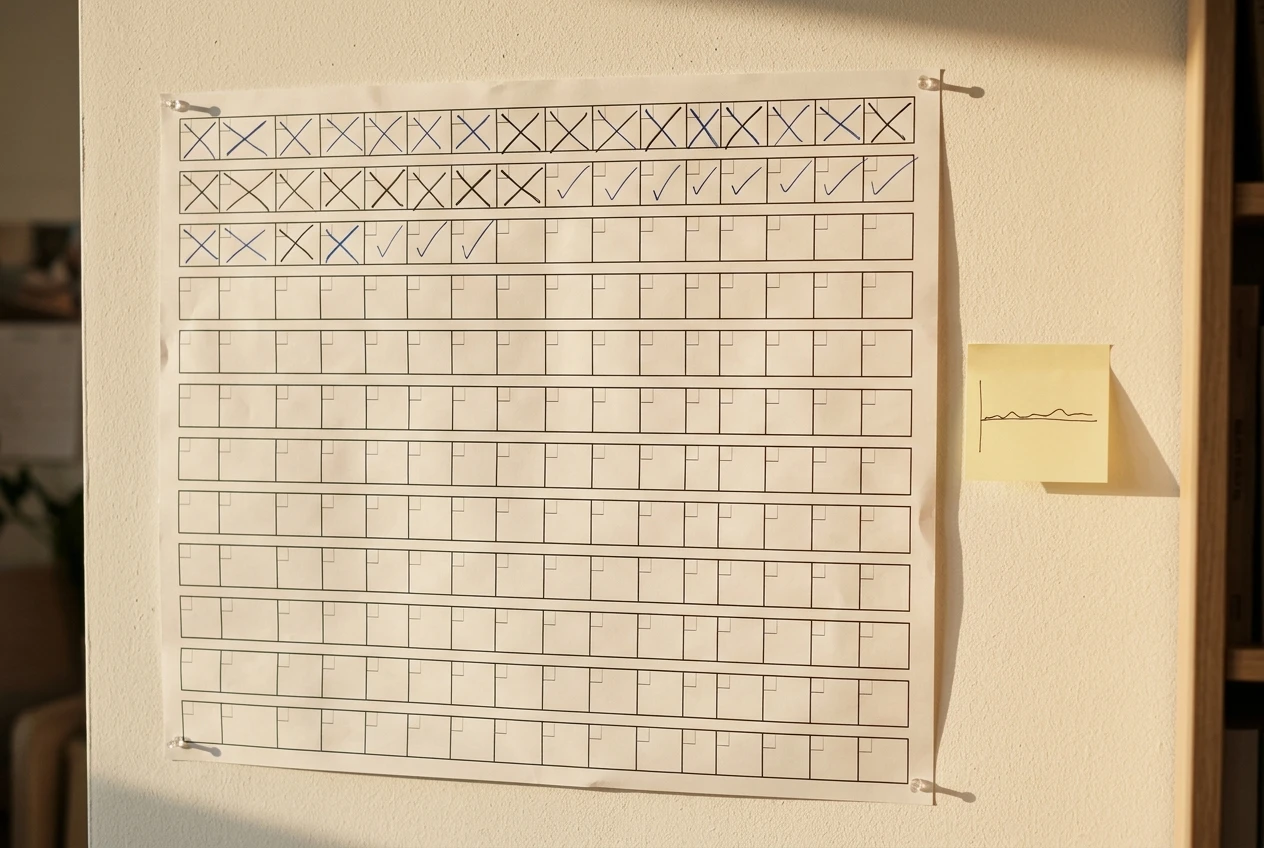
Weeks 3 to 6: publishing into silence. You publish one article a week and some social posts. Traffic is close to zero. You may see a handful of visits, many of them from you. Search engines can take a while to index and rank new pages, so a quiet analytics page in this period is expected and says little about whether your work is good.
Weeks 7 to 10: first signals. If your articles target the right questions, small numbers of visitors begin to arrive. A few may click through to the offer. A sale in this window is possible but should not be assumed. What you are looking for is evidence that the chain works: visits, then clicks, then email signups.
Weeks 11 to 13: adjust. By now you have enough data to see what is working, even if the numbers are small. Improve the pages that get visits, write more like them, and fix the ones that get visitors but no clicks.
There will be slow weeks. There will be weeks where you publish something and nothing happens, and weeks where life interrupts and you publish nothing. Neither one ruins the plan. What ruins it is stopping at week 5 because the line on the graph is flat, which is when most of the work is still waiting to be found.
Set your expectations at the level of effort, not the level of income. “Publish weekly for 13 weeks” is a goal you control. “Earn $1,000 by day 90” is an outcome that depends on your niche, your offer, and some luck. Some people will get there in 90 days and many will need longer. The sum tells you how far you have to go, and the calendar tells you how long you have been walking.
When to double down and when to change course
At the end of the first stretch, you will have data, and the data points to specific fixes. Use the arithmetic from the start to find where the chain is breaking:

- Few visitors. This is a traffic problem. Write more articles aimed at specific questions, and look at which of your pages get any visits at all. Make more of those.
- Visitors, but few clicks to the offer. The page is not persuading. Rework the headline, make the recommendation clearer, and put the link where readers will see it. The landing page guide is the place to look first.
- Clicks, but no sales. Either the audience does not match the offer, or the offer’s own page is not converting. Re-read your niche sentence from earlier. You may be attracting people who are curious but not buyers, and a different article angle or a different offer could fix that.
- Sales, but too few. Congratulations, the chain works. Now it is a volume problem, so repeat what produced the sale.
To see these numbers you need basic analytics. Google Analytics without the headache covers the five questions worth answering for your site, which is plenty for this stage.
Double down when a specific page or topic is producing visits or clicks, even in small amounts. A small signal that repeats is more useful than a big number that appeared once. Change course when you have done the work for a full 90 days, followed the plan, and the chain shows no signal at any point: no visits, no clicks, no signups. At that point, change one thing at a time, such as the niche angle, the offer or the platform, so that you can tell which change made the difference.
Once email subscribers start to arrive, an automated sequence can follow up with people who did not buy on the first visit. The article on five emails that sell while you are away from your desk describes a simple one to set up.
Write your sum today
Open a notes file and write three lines: the offer you are considering, the commission per sale, and how many sales add up to $1,000. Then divide by a conversion rate you will replace with real data later, and see how many visitors a day that implies.
Then do the first job on the roadmap this week: choose your single path, affiliate marketing, and shortlist two or three offers you could explain to a friend in two sentences. The rest of the plan follows from that decision.